Coursera's Latest Data Reveals Encouraging Progress in Closing the Gender Gap for Generative AI Skills
Global Progress in Bridging the GenAI Skills Gender Gap
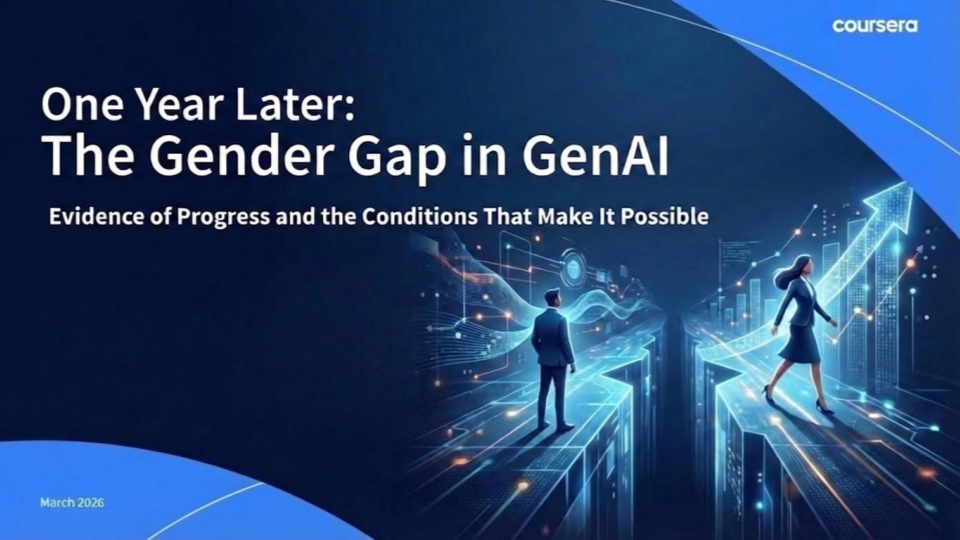
As the world marks International Women’s Day, a new report from Coursera offers a hopeful picture: the gender gap in learning Generative AI (GenAI) and other critical human skills is narrowing. The analysis, titled One Year Later: The Gender Gap in GenAI, builds on last year’s baseline study and reveals that women’s participation in GenAI courses on the platform has risen from 32% in 2024 to 36% in 2025 — a clear sign that more women are equipping themselves with the skills needed to thrive in an AI-driven economy.
GenAI is projected to add as much as USD $22.3 trillion to the global economy by 2030, according to IDC research. For these gains to be shared equitably, it’s essential that women and underrepresented groups have access to training in these transformative technologies. The Coursera report highlights that while challenges remain, the pace of change is accelerating.
Enterprise Learners Show Faster Progress
Among enterprise learners — those taking courses through their employers — the gender gap is closing even more rapidly. In 2024, women accounted for 36% of GenAI enrollments in this segment; by 2025, that figure had jumped to 42%. This is especially encouraging given the overall surge in GenAI course enrollments across all demographics. The data suggests that women’s engagement with the technology is growing faster than men’s within the enterprise context.
Regional Variations: Where Progress Is Strongest — and Where It’s Stalled
Although the global trend is positive, the report uncovers significant regional differences in how quickly the gender gap is closing.
Latin America Leads the Way
Latin American nations have doubled their share of women enrolling in GenAI courses on Coursera year over year. Standout performers include Peru, which saw a remarkable increase of 14.5 percentage points; Mexico, with a 5.3-point gain; and Colombia, which added 4.5 percentage points. These results reflect targeted educational initiatives and growing awareness of the importance of gender equity in tech.
Asia Pacific Shows Consistent Improvement
In the Asia Pacific region, several countries are narrowing the gap. Uzbekistan stands out globally, recording an 8.8 percentage point increase in female GenAI enrollments. India, Coursera’s largest market for GenAI courses, posted a 2.2 percentage point rise. Vietnam, Indonesia, Thailand, and the Philippines also reported year-over-year gains in the share of women taking GenAI courses.
Developed English-Speaking Countries Lag Behind
In contrast, many economically developed, English-speaking countries have seen the gap widen. The United States experienced a 0.9 percentage point decline in women’s share of GenAI enrollments; Canada dropped by 1.0 point; the United Kingdom by 1.8; Spain by 1.1; and Germany by 0.2. These declines suggest that in these regions men are enrolling in GenAI courses at a faster rate than women, possibly due to existing gender biases in tech fields or differences in professional development opportunities.
Looking Ahead: Strategies to Sustain Momentum
The Coursera report underscores that while progress is real, it is uneven. To accelerate the closing of the gender gap, the study suggests institutions and employers should:
- Promote awareness of GenAI career pathways among women and girls.
- Offer targeted scholarships or mentorship programs.
- Create inclusive learning environments that address unconscious bias.
- Encourage enterprise-led upskilling that reaches women equally.
As International Women’s Day reminds us, economic empowerment of women is not just a matter of fairness — it’s a strategic imperative. With GenAI poised to reshape the global economy, ensuring that women are full participants is essential for a more balanced and prosperous future.
Related Articles
- From Coding Newbie to Agent Builder: My Journey to Create a Leaderboard-Cracking AI
- AI Researchers Issue Urgent Warning: 'Reward Hacking' Threatens Safe Deployment of Autonomous AI Systems
- Kazakhstan's Ministry Renews Coursera Partnership to Advance Digital and AI Education for Students
- Kubernetes v1.36: 8 Things You Need to Know About Mutable Pod Resources for Suspended Jobs (Beta)
- Medical Students Speak Out: Education Gaps in Nutrition and Preventive Care Exposed
- Stanford's TreeHacks 2026: A 36-Hour Marathon of Innovation and Social Impact
- How to Post Your Job Seeker Profile in the Hacker News 'Who Wants to Be Hired?' Thread
- Turning AI Insights into Team Wisdom: Building a Structured Feedback Loop