Navigating Away from the Sea of Nodes: V8's Shift to Turboshaft
Introduction
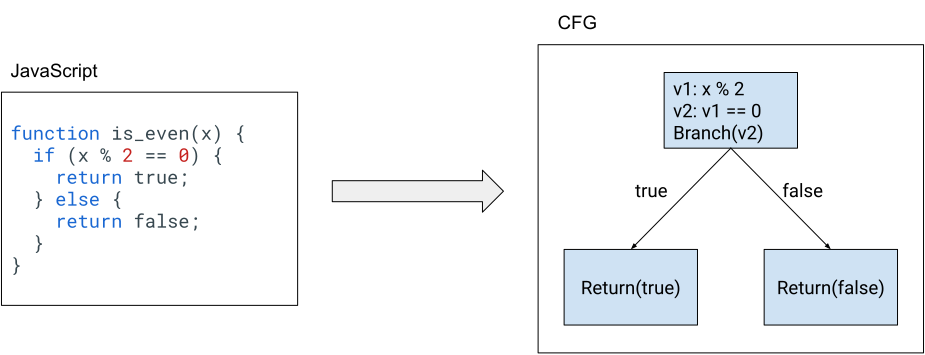
For over a decade, V8's optimizing compiler, Turbofan, has been one of the few production compilers to rely on the Sea of Nodes (SoN) intermediate representation (IR). However, in a strategic move that began nearly three years ago, the V8 team has been gradually phasing out Sea of Nodes in favor of a more traditional Control-Flow Graph (CFG) IR named Turboshaft. Today, the entire JavaScript backend of Turbofan runs on Turboshaft, and the WebAssembly pipeline uses it exclusively. Only two areas remain tied to Sea of Nodes: the builtin pipeline (being slowly replaced) and the frontend of the JavaScript pipeline, which is being superseded by Maglev, another CFG-based IR. This article delves into the reasons behind this architectural pivot.
The Birth of Turbofan and Sea of Nodes
A dozen years ago, in 2013, V8 had a single optimizing compiler: Crankshaft. Crankshaft used a CFG-based IR and, despite its early limitations, delivered impressive performance gains. Over the following years, the team continuously improved it to handle more scenarios and generate faster code. Yet, mounting technical debt and several fundamental issues began to hinder further progress.
The Challenges That Drove the Change
Crankshaft struggled with several critical limitations:
- Excessive hand-written assembly code: Every new operator added to the IR required manual assembly translation for all four supported architectures (x64, ia32, arm, arm64). This was error-prone and time-consuming.
- Poor optimization of asm.js: At the time, asm.js was seen as a key stepping stone to high-performance JavaScript, but Crankshaft failed to optimize it effectively.
- Inability to introduce control flow during lowerings: Control flow was finalized at graph building time. This prevented common compiler transformations like lowering a high-level operation (e.g.,
JSAdd(x,y)) into lower-level code with conditional branches (e.g., if both are strings, callStringAdd; otherwise, use a different path). - No support for try-catch: Multiple engineers spent months trying to implement try-catch support, but without success.
- Severe performance cliffs and bailouts: Using certain features or hitting edge cases could cause a 100x performance drop, making it unpredictable for developers.
- Deoptimization loops: Crankshaft would speculate optimistically, get deoptimized when assumptions failed, and then reoptimize with the same flawed assumptions, leading to endless cycles of poor performance.
These issues made it clear that a new approach was needed.
Why Sea of Nodes Was Chosen (and Why It Worked for a While)
To overcome Crankshaft's limitations, the V8 team turned to the Sea of Nodes representation. SoN was designed to allow more flexible scheduling and optimization by representing both data and control dependencies in a single graph. It enabled features like lazy lowering and better global optimization. For several years, Turbofan with SoN served V8 well, powering significant performance improvements across JavaScript and WebAssembly workloads.
Why Leave the Sea of Nodes?
Despite its initial advantages, SoN introduced its own complexities. The graph-based representation made certain optimizations hard to reason about and debug. The compiler's pipeline became increasingly intricate, and maintaining correctness across edge cases grew costly. Moreover, the rise of WebAssembly and new JavaScript patterns required more predictable and faster compilation. The team realized that a control-flow graph IR could offer a simpler, more maintainable foundation while still achieving high performance—especially with modern compiler techniques like single-pass register allocation and linear scan.
Thus, Turboshaft was born—a CFG-based IR designed from the ground up for clarity and speed. It retains the best ideas from SoN (like effect phis and value phis) but packages them in a more traditional control-flow framework. The result is a compiler that is easier to develop, debug, and optimize.
The Current State and Future Outlook
Today, Turboshaft has replaced the Sea of Nodes in the JavaScript backend and throughout the WebAssembly pipeline. The remaining legacy spots—the builtin pipeline and the JavaScript frontend—are being systematically migrated. The builtin pipeline is gradually transitioning to Turboshaft, while the frontend is being replaced by Maglev, another CFG-based compiler that focuses on fast, non-optimizing compilation. This dual approach (Turboshaft for full optimization, Maglev for quicker passes) allows V8 to balance compile time and code quality.
Looking ahead, the V8 team expects continued performance gains from Turboshaft's simpler architecture. Developers writing JavaScript or WebAssembly can anticipate more predictable optimization and fewer mysterious slowdowns. The departure from the Sea of Nodes marks not a retreat, but a strategic evolution toward a more sustainable and performant compilation infrastructure.
Conclusion
Leaving the Sea of Nodes was a bold decision, but one grounded in hard-won experience. By adopting Turboshaft, V8 has streamlined its compiler pipeline, addressed long-standing maintenance challenges, and positioned itself for future innovations. For developers, this means faster, more reliable code generation—and a clearer path to high-performance web applications.
Related Articles
- How to Stay Informed on Sustainable Transport and Energy News
- 10 Key Facts About AGL's Battery Approval in Coal Country and the Legless Lizard Protection
- Green Tea: Go's New Experimental Garbage Collector Explained
- Rivian Secures $4.5 Billion DOE Loan for Georgia EV Factory Despite Policy Uncertainty
- How to Maximize Savings on Electric Bikes, Scooters, and Gear This Week
- Wind Farm Stalls Under National Security: What You Need to Know
- Massachusetts Unveils Landmark Speed-Based Micromobility Law as First in Nation
- EU Faces Pressure on Methane Rules as Renewables Surge and Climate Risks Mount