Meta's Latest Enhancements for End-to-End Encrypted Backups: A Q&A Guide
Meta has recently introduced significant updates to its end-to-end encrypted backup systems for WhatsApp and Messenger. These enhancements build upon the foundational HSM-based Backup Key Vault, which secures users' message history using hardware security modules (HSMs) and recovery codes. The two main improvements are an over-the-air fleet key distribution mechanism for Messenger and a commitment to publishing evidence of secure HSM fleet deployments. This Q&A guide explains these changes in detail, helping you understand how Meta is reinforcing the security of your backups.
1. What is Meta's HSM-based Backup Key Vault and how does it protect backups?
The HSM-based Backup Key Vault is a secure infrastructure that underpins end-to-end encrypted backups for WhatsApp and Messenger. It allows users to protect their backed-up message history by generating a recovery code, which is stored in tamper-resistant hardware security modules (HSMs). These HSMs are deployed across multiple datacenters in a geographically distributed fleet, ensuring resilience through majority-consensus replication. Critically, the recovery code remains inaccessible to Meta, cloud storage providers, or any third party. This design means that even if Meta's systems are compromised, no one except the user can decrypt their backup. The vault thus provides a strong foundation for user privacy, making it the cornerstone of Meta's encrypted backup strategy.

2. How does the over-the-air fleet key distribution work for Messenger?
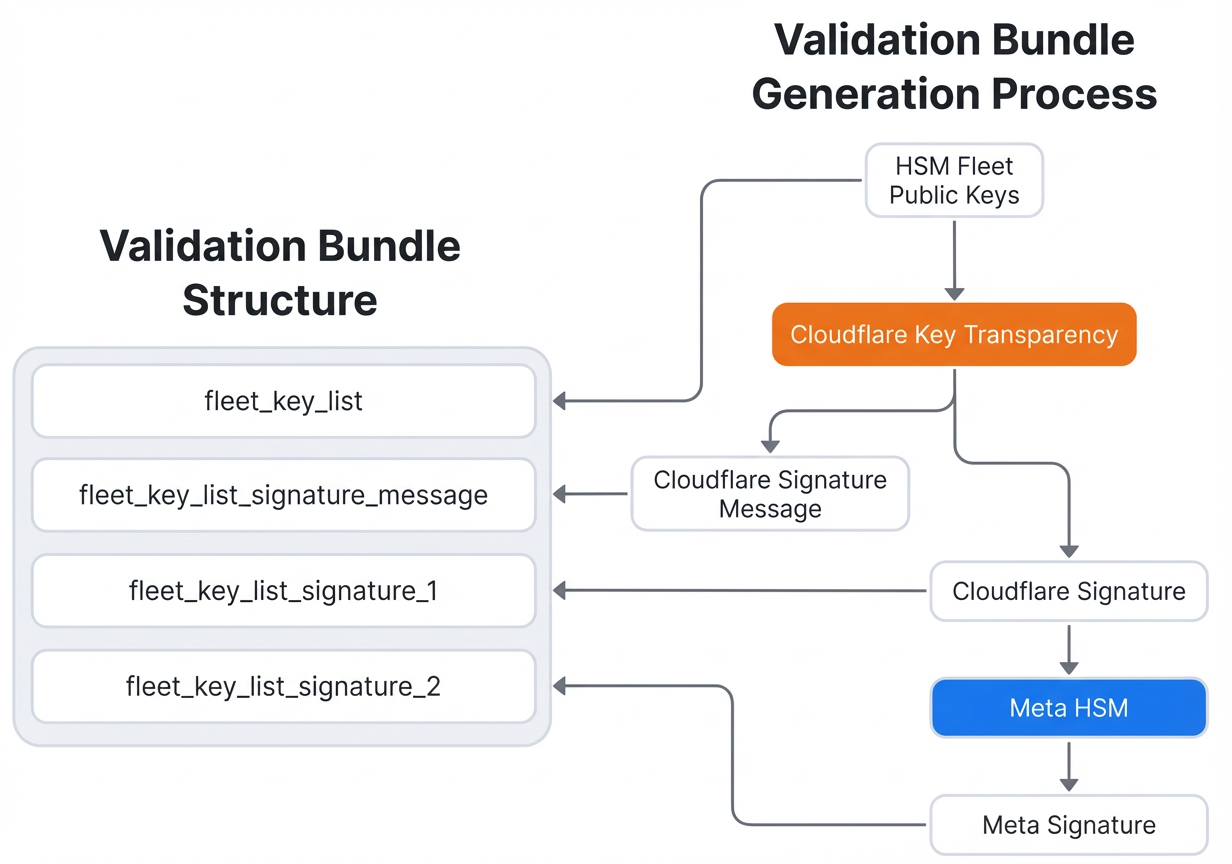
To verify the authenticity of an HSM fleet, clients need to validate the fleet's public keys before establishing a session. In WhatsApp, these keys are hardcoded into the app. However, for Messenger—where new HSM fleets may need to be deployed without requiring an app update—Meta built a mechanism to distribute fleet public keys over the air. This is achieved through a validation bundle that is part of the HSM response. The bundle is first signed by Cloudflare and then counter-signed by Meta, providing independent cryptographic proof of authenticity. Additionally, Cloudflare maintains an audit log of every validation bundle, allowing for external verification. This approach ensures that even if no app update is available, users can trust that they are connecting to a legitimate HSM fleet. The full validation protocol is described in Meta's whitepaper.
3. Why is Meta committing to publishing evidence of secure HSM fleet deployments?
Transparency is key to demonstrating that the HSM fleet system operates as designed and that Meta cannot access users' encrypted backups. By committing to publish evidence of the secure deployment of each new HSM fleet on its blog, Meta allows anyone to verify that the infrastructure is set up correctly and without backdoors. New fleet deployments are infrequent—typically every few years—but each one represents a critical point of trust. Any user can follow the steps outlined in the Audit section of Meta's whitepaper to independently verify that a new fleet is deployed securely. This move reinforces Meta's leadership in secure encrypted backups and gives users concrete assurance that their data remains private, even from Meta itself.
4. How does Meta ensure that the recovery code remains inaccessible to itself or third parties?
The recovery code for end-to-end encrypted backups is generated on the user's device and stored directly in the HSM-based Backup Key Vault. The vault uses tamper-resistant hardware security modules (HSMs) that are physically and logically protected. These HSMs are deployed across multiple datacenters in a geographically distributed fleet, and any operation on the vault requires a majority-consensus from the fleet. This means that no single entity—including Meta, cloud storage providers, or any third party—can access the recovery code without the user's consent. Additionally, the code is never transmitted or stored in a way that Meta could read. This architecture ensures that the backup remains truly end-to-end encrypted, with the user holding the only key.
5. What role does Cloudflare play in the validation bundle for fleet keys?
Cloudflare acts as an independent auditor in Meta's over-the-air fleet key distribution system. When a new HSM fleet is deployed, its public keys are packaged into a validation bundle. This bundle is first cryptographically signed by Cloudflare, which holds its own independent keys. Then Meta counter-signs the bundle, producing a doubly signed artifact. The signature by Cloudflare provides an outside party's attestation that the bundle is authentic and hasn't been tampered with. Additionally, Cloudflare maintains an audit log of every validation bundle it signs, enabling retrospective verification. This independent oversight ensures that even if Meta's own systems were compromised, the authenticity of fleet keys can still be validated. It adds a layer of trust that goes beyond simple self-attestation.
6. Where can users find the complete technical specifications?
For the full technical specification of the HSM-based Backup Key Vault and the over-the-air key distribution system, Meta has published a whitepaper titled “Security of End-To-End Encrypted Backups.” This document provides a detailed description of the cryptographic protocols, HSM architecture, validation mechanisms, and audit procedures. It includes step-by-step instructions for verifying fleet deployments and understanding how the system resists attacks. The whitepaper is available on Meta's engineering blog and is free to download. Reading it gives security researchers, privacy advocates, and curious users a deep dive into the engineering that makes end-to-end encrypted backups trustworthy. Meta recommends all interested parties refer to this paper for the authoritative technical description.
Related Articles
- Anatomy of a Nation-State Cyber Espionage Campaign: Understanding SHADOW-EARTH-053
- Credential Theft via Supply Chain: PyTorch Lightning and Intercom-client Packages Compromised
- 6 Critical Facts About the Dirty Frag Linux Root Exploit You Can't Ignore
- Unmasking the OceanLotus PyPI Attack: ZiChatBot Malware Explained
- The Downfall of ‘Tylerb’: 8 Key Facts About the Scattered Spider Hacker’s Guilty Plea
- How to Achieve High-Fidelity AI Vulnerability Detection: Lessons from Mozilla's Mythos Integration
- Python 3.14.2 and 3.13.11: Quick Fixes for Regressions and Security Issues
- Critical Windows BitLocker Vulnerabilities: YellowKey and GreenPlasma Explained