The Celestial Display Above Earth: Airglow and the Milky Way from the ISS
A Gateway to the Cosmos
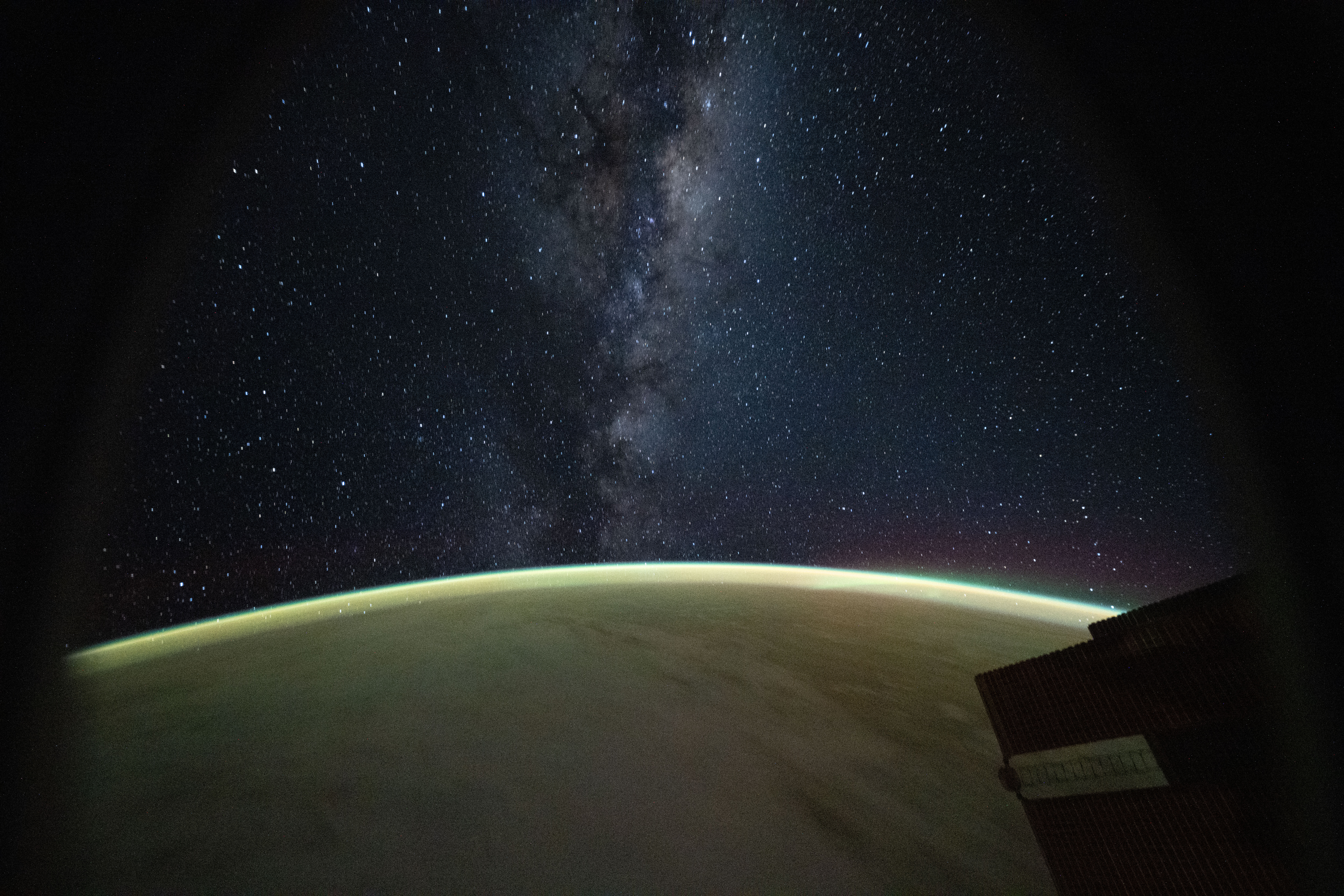
From the vantage point of the International Space Station (ISS), astronauts are treated to an ever-changing panorama of our planet and the universe beyond. On April 13, 2026, NASA astronaut Chris Williams captured a particularly stunning sight: the Milky Way galaxy rising above Earth’s ethereal atmospheric glow. The image, taken from inside a SpaceX Dragon capsule docked to the ISS, offers a rare blend of terrestrial and celestial beauty, highlighting the delicate interplay between sunlight, our atmosphere, and the stars.
Capturing the Moment
Williams used a camera setup to photograph the galactic core of the Milky Way as it emerged from behind the planet’s curved horizon. The result is a luminous band of billions of stars contrasted against a soft, colorful haze—the airglow that perpetually envelops Earth. This phenomenon, often mistaken for auroras, is a constant feature of the upper atmosphere, visible even from ground-based observatories under dark skies.
What Is Airglow?
Airglow, also called nightglow when it occurs at night, is the faint emission of light by Earth’s upper atmosphere. It arises from two primary processes. First, atoms and molecules in the mesosphere and thermosphere become excited by sunlight during the day. To shed this excess energy, they release photons—particles of light. Secondly, atoms and molecules that have been ionized by solar radiation can capture free electrons, also emitting photons as they return to a neutral state. Both mechanisms produce a diffuse glow that ranges in color from green to red to yellow, depending on the altitude and the chemical species involved (e.g., oxygen atoms emit green light at higher altitudes, while sodium atoms create a yellow hue).
Unlike auroras, which are driven by charged particles from the solar wind colliding with the magnetosphere, airglow is powered by ordinary, day-to-day ultraviolet radiation from the Sun. This makes airglow a quieter but more persistent phenomenon—a subtle reminder that even without dramatic solar storms, our atmosphere is constantly shimmering in response to sunlight.
Airglow vs. Aurora: A Celestial Comparison
Both airglow and auroras are examples of atmospheric luminescence, but their origins and dynamics differ fundamentally. Auroras occur when high-energy particles from the solar wind funnel along Earth’s magnetic field lines and collide with oxygen and nitrogen molecules in the upper atmosphere, creating spectacular curtains of color that shift rapidly. In contrast, airglow is a global, steady emission that arises from the recombination of ions and the de-excitation of atoms after they absorb sunlight. While auroras are most prominent near the polar regions, airglow can be observed from any part of Earth, though it is dimmer and requires sensitive equipment to see from the ground.
For astronauts like Williams, airglow provides a constant, soft backdrop to the stars. In his image, the Milky Way appears to rise through this glowing layer, giving the view a dreamlike quality that underscores how interconnected our world is with the solar radiation that fuels both life and light.
Why This Observation Matters
Such images are more than just aesthetically pleasing—they serve as valuable data points for scientists studying upper-atmospheric chemistry and dynamics. By analyzing the colors and intensity of airglow, researchers can learn about the temperature, density, and composition of the mesosphere and thermosphere. Moreover, the presence of the Milky Way in the frame offers a striking reminder of our place in the galaxy. The ISS orbits just a few hundred kilometers above Earth’s surface, yet from that height, the cosmic perspective is profoundly humbling.
Chris Williams’s photograph, released by NASA, quickly became a talking point on social media, inspiring wonder and curiosity about the boundary between Earth and space. It also highlights the role of astronauts as citizen scientists, using their unique vantage point to document both terrestrial and celestial phenomena.
In summary, the image captures a moment where sunlight, atmosphere, and the Milky Way converge—a fleeting but beautifully orchestrated display of airglow and starlight, reminding us that even in the quietest nights, our planet never stops glowing.
Related Articles
- 10 Fascinating Facts About the Mysterious Crystals from the First Nuclear Bomb Test
- The Hidden Reversal: How Climate Change Transforms Winter Lakes
- How Squid and Cuttlefish Outlasted Mass Extinctions: A Q&A
- 4 Amazing Science Discoveries That Slipped Under the Radar
- T-Mobile Expands Satellite Roaming: 7 Things You Need to Know About Connectivity in Canada and New Zealand
- 10 Key Insights into GRASP: Revolutionizing Long-Horizon Planning with World Models
- How to Recreate Life's Spark: A Guide to Freeze-Thaw Chemistry with Lipid Membranes
- Shocking Discoveries: 7 Ways Our Understanding of Lightning Has Evolved