Supply Chain Breach at CPUID: SentinelOne’s AI EDR Blocks Stealthy Watering Hole Attack
Attackers Hijacked Official CPU-Z Downloads for 19 Hours
On April 9, 2026, millions of users who downloaded the popular CPU-Z utility from the official cpuid.com website received a malicious payload instead of the legitimate tool. Threat actors compromised the domain at the API level, silently redirecting all download requests to attacker-controlled infrastructure. The attack ran for approximately 19 hours before being neutralized.

“Users who navigated directly to the official site received a properly signed binary with a malicious payload bundled inside it,” said a SentinelOne threat intelligence analyst. “The trust chain broke above them—they followed every instruction they’d been given.”
How the Attack Unfolded: Real-Time Detection
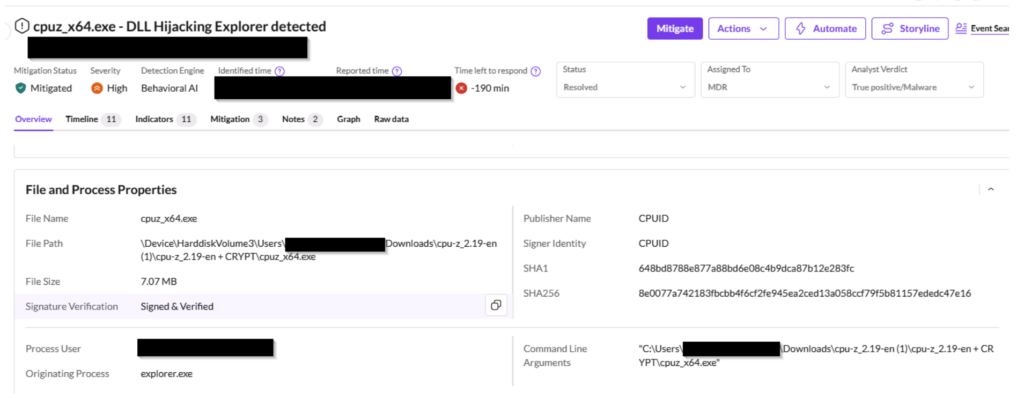
SentinelOne’s behavioral AI agent flagged the first anomaly within seconds of execution. The binary cpuz_x64.exe was genuine, digitally signed, and came from the vendor’s own infrastructure—but its process chain revealed the deception. The executable spawned PowerShell, which spawned csc.exe, which spawned cvtres.exe. CPU-Z never does that.
“The detection came from what the process was doing, not where it came from,” explained the analyst. “Five specific behavioral indicators converged, triggering our ‘Penetration framework or shellcode was detected’ alert.”
Five Converging Behavioral Indicators
- Anomalous API resolution: The process located system functions through non-standard discovery methods, bypassing the OS loader entirely.
- Reflective code loading: Executable code ran in memory regions with no corresponding file on disk.
- Suspicious memory allocation: Read-Write-Execute (RWX) memory permissions were requested—a classic staging pattern for malicious payloads.
- Process injection patterns: Execution flow consistent with code being redirected into a secondary process to mask its origin.
- Heuristic shellcode signatures: Sequential operations characteristic of automated exploitation toolkits preparing an environment for command execution.
The agent autonomously terminated and quarantined the involved processes before the attack could advance further. The malicious CRYPTBASE.dll placed in the application directory was blocked from executing.
Background: A Systemic Shift in Software Supply Chain Attacks
This attack is not an isolated incident. SentinelOne’s Annual Threat Report identifies a “systemic shift” where the identity of a trusted developer becomes the vector of attack. In late 2025, the GhostAction campaign saw a compromised GitHub maintainer account push malicious workflows to extract secrets. A concurrent phishing attack against an NPM maintainer deployed code that intercepted cryptocurrency transactions. In both cases, commit logs appeared legitimate because they originated from accounts with valid write access.
“The CPUID incident extends this pattern to software distribution itself,” noted the report. “The supplier’s download infrastructure became the delivery channel.” The attackers compromised the API layer, not just the website frontend, making the attack invisible to traditional checksums and signing.
What This Means for the Security Community
Trusted software vendors can no longer be assumed secure. Even when a binary is signed and comes from an official source, the underlying infrastructure may be compromised. Behavioral detection—watching what a process does rather than where it comes from—is now critical for defending against supply chain attacks.
For IT teams using CPU-Z, HWMonitor, HWMonitor Pro, or PerfMonitor, this breach underscores the need for runtime defense. “The next attack will work the same way,” warned the analyst. “Organizations must pivot from trust-by-origin to trust-by-behavior.” SentinelOne’s AI EDR provides that capability, autonomously blocking the attack within the first seconds of execution, before any payload could execute.
Users should verify their CPU-Z binaries against known good hashes and ensure endpoint defenses include behavioral analysis. The window between compromise and detection is shrinking, but only if the right tools are in place.
Related Articles
- April 2026 Patch Tuesday: Record-Breaking Security Updates Address 167 Flaws, Including Actively Exploited Vulnerabilities
- 8 Critical Facts About the JDownloader Site Hack and Python RAT Distribution
- Build Your Own Apple Lisa on an FPGA: A Comprehensive Guide
- Cybersecurity Week 19: Justice Served and a New Cloud Worm Emerges
- April 2026 Patch Tuesday: Microsoft Fixes 167 Flaws, Including Actively Exploited Zero-Days
- BlackCat Ransomware: Two Cybersecurity Professionals Sentenced to Four Years in Prison
- Mastering Peristaltic Pumps: Key Questions and Expert Answers
- Massive Russian Cyber Operation Exploits Old Routers to Steal Microsoft Authentication Tokens