The Avian Eye: Nature's Optical Masterpiece
Birds have evolved some of the most remarkable visual systems in the animal kingdom. From the eagle's razor-sharp long-distance sight to the owl's nocturnal hunting prowess, avian eyes are pushed to evolutionary extremes. This Q&A explores the unique adaptations that make bird vision so extraordinary, including their color perception, focusing speed, and structural innovations.
1. Why do birds have such large eyes compared to their skull size?
Birds rely heavily on vision for survival, so their eyes take up a large proportion of the skull. Unlike mammals, which have medium-sized eyes relative to head size, birds have evolved enormous eyes that fill much of the orbit. This large size allows for a bigger pupil and a longer focal length, which improves light-gathering ability and image resolution. For example, a great horned owl’s eyes are roughly the same size as a human’s, even though the bird weighs only about 1.5 kilograms. The trade-off is that avian eyes are nearly immobile within the socket, forcing them to move their heads to change their view. This adaptation is why you see owls rotating their heads up to 270 degrees—their fixed eyes demand exceptional neck flexibility.
2. How many types of color photoreceptors do birds have, and why is that significant?
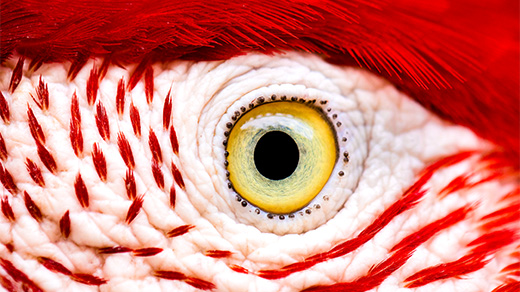
Most birds are tetrachromatic, meaning they have four types of cone cells for color vision, while humans only have three. The fourth cone type is sensitive to ultraviolet (UV) light, allowing birds to see a world invisible to us. This UV vision is crucial for tasks such as identifying ripe fruits, detecting prey marks, and recognizing mates. For instance, many bird feathers reflect UV patterns that are invisible to mammalian predators but vivid to other birds. The oil droplets inside bird cones further refine color perception by filtering specific wavelengths, reducing overlap between cone responses and enhancing color discrimination. In species like the pigeon and the hummingbird, this expanded palette helps them navigate complex environments and find food more efficiently.
3. What is a fovea, and why do some birds have more than one?
The fovea is a tiny pit in the retina where photoreceptors are most densely packed, providing the sharpest vision. Most birds have a single fovea near the center of the retina, but many raptors, such as the peregrine falcon, possess two foveas—a central one for forward vision and a temporal one for sideways or binocular vision. This dual-fovea setup allows birds to simultaneously track prey with a head-on view and monitor the horizon for obstacles. Each fovea has a high density of cones (up to 1 million per square millimeter), giving these birds extraordinary visual acuity. Eagles can spot a rabbit from two miles away because their foveas act like telephoto lenses, magnifying the image on the retina. This adaptation is a key reason why raptors dominate as aerial hunters.
4. How do birds achieve such rapid focus (accommodation) compared to humans?
Birds can change the shape of their lens much faster than mammals due to unique muscle structures. While humans use ciliary muscles to adjust the lens curvature slowly, birds have a striated (voluntary) ciliary muscle that can contract rapidly, allowing near-instantaneous focus shifts. In addition, many birds possess a cornial accommodation mechanism where they can alter the curvature of the cornea by contracting muscles around the eye. This dual system enables a hawk diving at 200 mph to track a moving rodent and adjust focus from far to near within milliseconds. The speed of accommodation is vital for catching prey or avoiding obstacles during flight. Interestingly, diving birds like the kingfisher have a specialized lens that can compensate for the refractive index of water, allowing them to see clearly underwater despite the change in medium.
5. What role do the pecten oculi play in bird eyes?
The pecten oculi is a unique, comb-like structure found only in avian eyes, protruding into the vitreous humor from the retina. Its primary function is to nourish the avascular retina, because birds lack the extensive retinal blood vessels that humans have. The pecten is rich in blood vessels and capillaries, providing oxygen and nutrients to the inner layers of the eye. Additionally, the pecten may help regulate pH and remove metabolic waste. Some researchers also believe its heavily pigmented surface reduces glare and enhances contrast by absorbing scattered light. In diurnal birds like the hawk, the pecten is large and pleated, while in nocturnal owls it is smaller. This structure is an evolutionary innovation that supports the high metabolic demands of bird vision without obstructing light pathways.
6. Why can some birds see polarized light, and how does that help them?
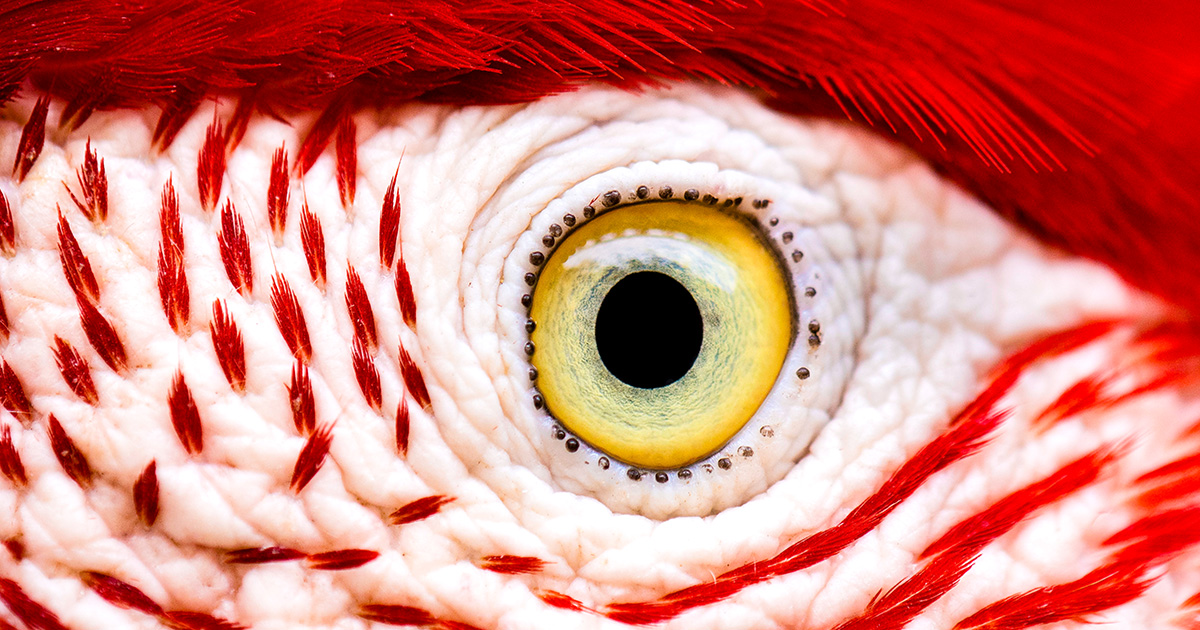
Many birds, especially migratory species like the European robin, possess the ability to perceive the direction of polarized light. Humans cannot normally see polarization, but birds have specialized photoreceptors in their eyes that detect the orientation of light waves. This skill allows them to use the sky’s polarization pattern as a compass, even when the sun is obscured by clouds. For example, during migration, birds calibrate their internal magnetic compass using polarized light cues at sunrise and sunset. The polarization pattern varies with the sun’s position, providing an accurate reference for orientation. Experiments have shown that displacing birds under a sky where polarization is rotated causes them to fly in the wrong direction. This visual adaptation is crucial for long-distance navigation across continents and oceans.
7. How does the bird eye’s structure protect it from high-speed impacts?
Birds that fly at high speeds—such as falcons and swifts—need eyes that can withstand sudden deceleration and air pressure. The bird eye is enveloped by a tough, bony structure called the sclerotic ring, which is a ring of small bones that support the eyeball and prevent it from collapsing under G-force. Additionally, the eyeball is tightly anchored within the orbit with strong connective tissue. The nictitating membrane, or third eyelid, sweeps horizontally across the eye to remove debris and moisten the surface without interrupting vision. In diving birds like the gannet, the nictitating membrane is transparent and can act as a lens underwater. These adaptations ensure that the bird eye remains functional even during the extreme accelerations of aerial combat or plunge diving. Combined with a robust cornea, the bird eye is built for resilience.
8. What evolutionary pressure drove the extreme specialization of bird eyes?
The extreme specialization of bird eyes is driven mainly by the demands of flight and predation. Flight requires rapid processing of visual information to avoid obstacles, navigate, and locate resources from great heights. Predatory birds must detect small, fast-moving prey from long distances, while prey birds must spot predators early. These pressures favor high spatial resolution, fast accommodation, broad spectral sensitivity, and excellent motion detection. The fossil record shows that bird ancestors, the theropod dinosaurs, already had relatively large eyes and good vision. Over 150 million years of evolution, avian eyes became progressively optimized. Birds that failed to see well enough to catch food or evade predators had lower survival rates, relentlessly selecting for visual superiority. The result is an eye that can see the tiniest insect, navigate by polarized light, and focus in a split second—all packed into a lightweight, resilient organ.
Related Articles
- T-Mobile Reverses Promo Cuts, Restores Four Free Devices per Account Amid Sales Staff Backlash
- The Enduring Wisdom of Brooks' Law: A Guide to Avoiding the Mythical Man-Month Trap
- Googlebook: The Android-Powered Laptop That Could Replace Chromebook
- Stay Ahead in Tech: Unlock Exclusive Insights with Tom's Hardware Premium
- 10 Things You Need to Know About Crossplay in Forza Horizon 6
- How to Scale a Developer Community and Plan a Successful CEO Transition
- GitHub Data Reveals 'Digital Complexity' of Nations, Study Shows Software Activity Predicts GDP and Inequality
- The Share the American Dream Pledge: A Path to Equitable Giving