Quantum Time Blur: How Spontaneous Collapse Theories Challenge Precision
Introduction: The Fuzzy Edge of Reality
Physicists have long grappled with a fundamental paradox in quantum mechanics: how do the probabilistic, fuzzy states of the quantum world give way to the definite, classical reality we experience? A new study proposes that the answer may lie in a subtle, gravity-linked spontaneous collapse process that introduces a tiny, inherent blur in the very fabric of time. While this effect is imperceptible in everyday life or even in today's most accurate atomic clocks, it sets a fundamental limit on how precise time measurements can ever be. The work opens a promising new direction toward reconciling quantum theory with general relativity.
Spontaneous Collapse: Making Quantum Fuzziness Definite
In standard quantum mechanics, particles exist in superpositions of multiple states until measured—a concept famously illustrated by Schrödinger's cat. The act of observation collapses the wave function into a single outcome. But what triggers this collapse? The Copenhagen interpretation treats it as a mathematical rule, while many-worlds theory denies collapse altogether. Spontaneous collapse models propose that collapse happens naturally, without observers, driven by an intrinsic physical process.
The Gravity Connection
The new research builds on a specific collapse model, sometimes called Diosi-Penrose, which ties collapse to gravitational effects. The idea is that when a particle's mass is in a superposition of two locations, the gravitational field becomes ambiguous, leading to tension that resolves through a spontaneous, rapid collapse. This would happen so quickly that macroscopic objects never remain in superpositions—explaining why we don't see quantum effects at our scale.
A Tiny Flaw in Time Itself
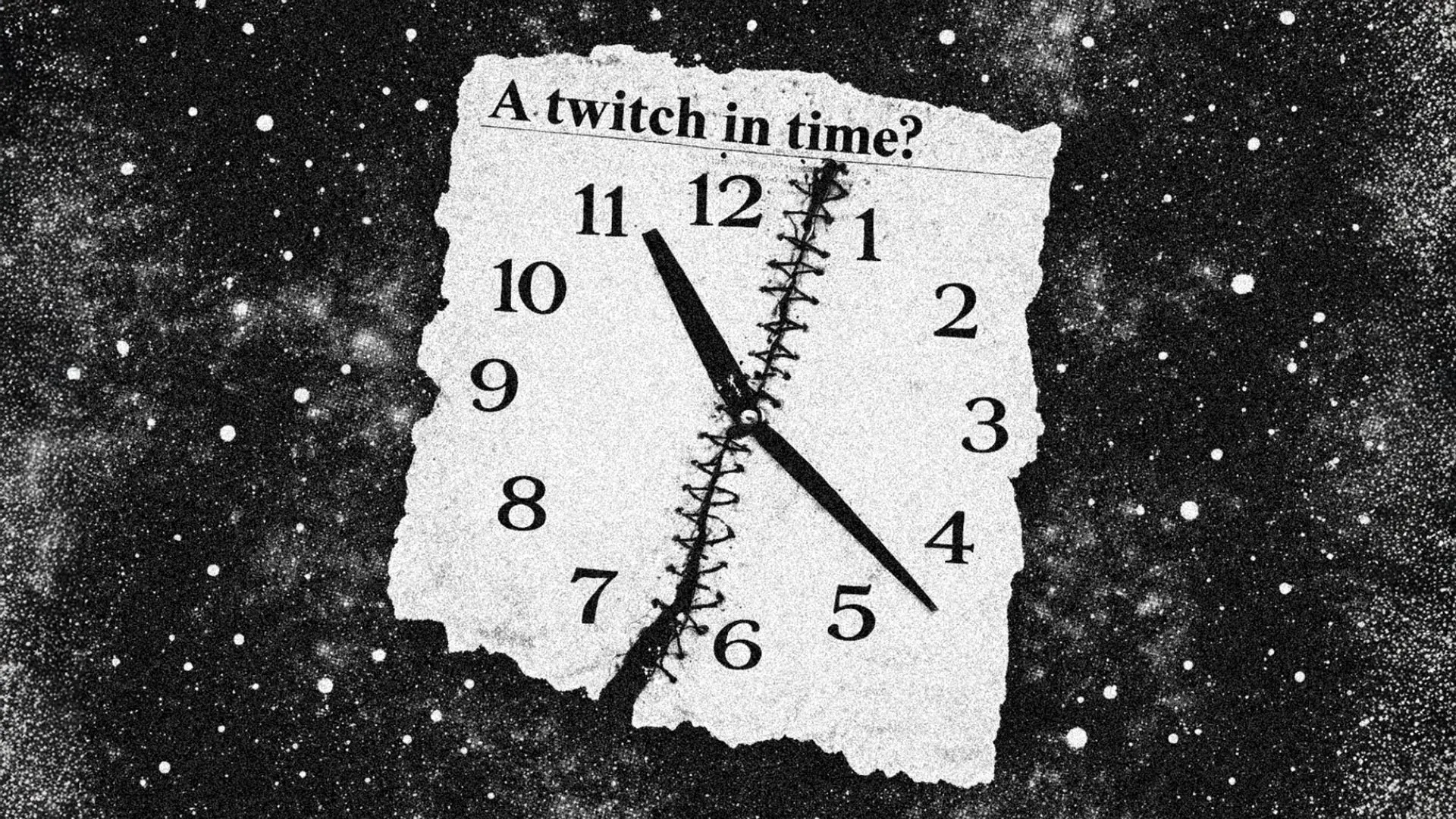
Here's where time enters the picture. The researchers discovered that this gravity-induced collapse process would cause a minuscule blur in the flow of time. In any measurement, the moment of collapse for a quantum system is not exactly defined; it occurs over a tiny interval. This jitter would show up as an irreducible uncertainty in time intervals, regardless of how precise a clock is built.
The effect is extraordinarily small—on the order of 10-34 seconds for typical atomic transitions. To put that in perspective, an atomic clock currently achieves precision of about 10-18 seconds. The blur predicted is so small that it would require a clock a million times more precise than today's best to even begin to detect it. Yet, theoretically, it imposes a hard limit on time resolution: no future clock can surpass it.
Implications for Physics and Cosmology
If confirmed, this would be a landmark discovery. First, it provides a testable prediction for spontaneous collapse models. Second, it offers a concrete link between quantum mechanics and gravity—the missing piece in the puzzle of quantum gravity. Many physicists believe that any theory uniting the two must predict deviations from classical time, and this blur could be that deviation.
Fundamental Limits on Timekeeping
Beyond basic science, the finding has practical implications for quantum metrology and fundamental constants. If time cannot be measured with arbitrary precision, then experiments that rely on ultra-precise timing (like tests of relativity or searches for dark matter) will eventually hit a wall. This also resonates with the Planck time (5.39×10-44 s), the smallest meaningful time scale in physics. The predicted blur is many orders larger, but still hints at a deep connection between quantum uncertainty and time's granularity.
What's Next: Toward Experimental Detection
While direct detection of the time blur is currently impossible, the team suggests indirect tests. For instance, extremely sensitive interferometers or spontaneous collapse experiments might reveal deviations from expected quantum behavior. The hope is that as technology improves, we may see the first hints of this time jitter, providing evidence for a theory that ties quantum collapse to gravity.
The work also informs other approaches to quantum gravity, such as loop quantum gravity and string theory, which predict discrete or fuzzy spacetime structures at the Planck scale. This new prediction sits at a different level—a dynamical blur arising from collapse, not from geometry.
Conclusion: A New Path to Unify Physics
The discovery of a minuscule flaw in time itself is more than a curiosity; it's a potential bridge between two pillars of modern physics. The idea that quantum collapse is spontaneous and gravity-driven leads naturally to a limit on time precision. Whether experiments eventually confirm this blur or not, the research highlights how thinking about the fuzzy edges of reality can illuminate the path toward a deeper theory of everything.
For those interested in the technical details, the original paper (published in Physical Review Letters) provides the mathematical framework. The key takeaway is that time may never be as crisp as we once thought—and that imperfection might be the clue we need to finally unite quantum mechanics with Einstein's gravity.
Related Articles
- A Step-by-Step Guide to Deciding If You Should Leave the Teaching Profession
- NASA Under Threat: Advocacy Leader Warns of 'Horrible Future' as Budget Cuts Loom
- Moon Lander Race Heats Up: Experts Warn of Risks in Scramble for Lunar Surface
- Beyond Efficiency: A Guide to Protecting Team Culture in the Age of AI Automation
- 10 Breakthrough Insights Into Rotated Lithium Niobate Crystals and Quantum Materials
- Ice Cycles May Have Sparked Life's First Cells, Study Reveals
- Exploring the Depths: A Q&A on Ann Leckie's Radiant Star
- Mastering Calm During Chaos: A Step-by-Step Guide